Ataytis Assurance · Fault Tree Analysis
Fault tree events and gates
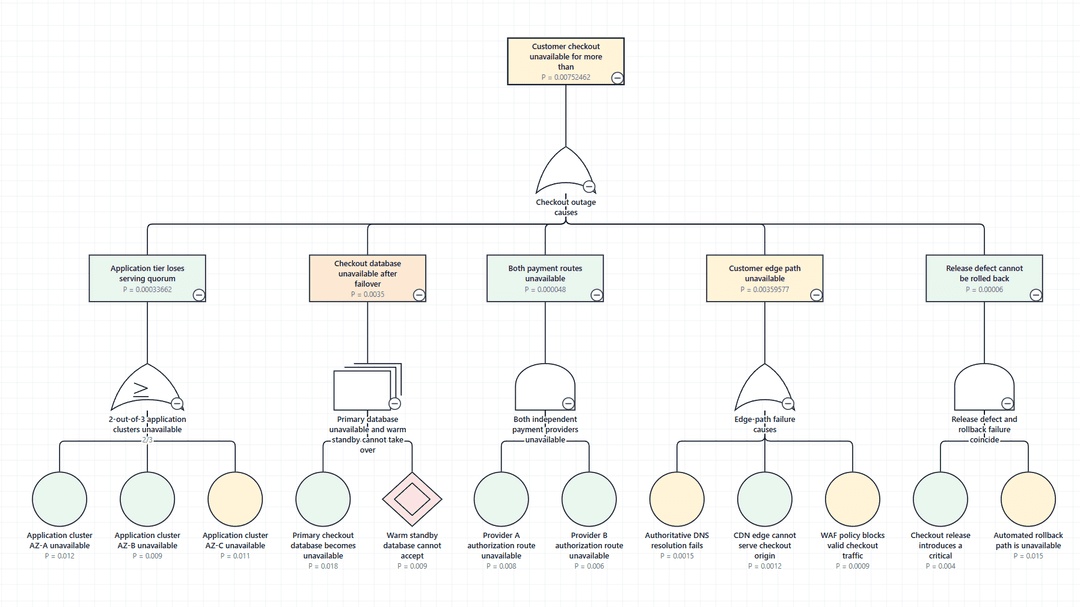
Every node type and relationship type a fault tree recognises, what to write in the Node Type column for each, and what each may connect to.
Events
| Node type | Write it as | Role in the tree |
|---|---|---|
| Top event | Top, Top Event, TE | The event being analysed. One per tree, with no parent and one gate beneath it. |
| Intermediate event | Intermediate, Intermediate Event, IE | An event developed further. One gate beneath it. |
| Basic event | Basic, Basic Event, BE | A failure that is not developed further. |
| Dormant event | Dormant, Dormant Event, DE | A basic event whose failure is dormant. Not developed further. |
| Undeveloped event | Undeveloped, Undeveloped Event, UE | An event deliberately not developed further. |
| House event | House, House Event, External, External Event, HE, EE | An event that is either certain or impossible. |
| Zero event | Zero, Zero Event, Impossible Event, False Event, ZE | An event that cannot occur. |
| Conditional event | Condition, Conditional, Conditional Event, Conditioning, Conditioning Event, CE | The condition attached to an INHIBIT, Priority AND or Sequential gate. |
Gates
| Node type | Write it as | Output occurs when |
|---|---|---|
| AND gate | AND, AND Gate, & | All inputs occur. |
| OR gate | OR, OR Gate | At least one input occurs. |
| Exclusive OR gate | XOR, XOR Gate, X-OR, EXOR, EOR, Exclusive OR | Exactly one of its two inputs occurs. |
| NOT gate | NOT, NOT Gate, Invert, Inverter | Its single input does not occur. |
| NAND gate | NAND, NAND Gate, Not AND | Not all of its inputs occur. |
| NOR gate | NOR, NOR Gate, Not OR | None of its inputs occur. |
| Inhibit gate | INHIBIT, INHIBIT Gate | Its input occurs while its condition holds. |
| Priority AND gate | PAND, Priority AND, Priority AND Gate | All inputs occur, in the order given by their priority sequence. |
| Sequential gate | SEQ, Sequential, Sequential Gate, Sequence Gate | Its inputs occur in the order given by their priority sequence. |
| Spare gate | SPARE, SPARE Gate | A primary input and its spares have failed, with the spares cold, warm or hot. |
| Voting gate | Vote, Voting, Voting Gate, Majority Vote, K/N, K out of N, M/N, M out of N, KooN | At least k of its n inputs occur. |
| Functional dependency gate | FDEP, FDEP Gate, Functional Dependency | Its trigger event forces its dependent events. Custom profile only. |
| Priority OR gate | POR, Priority OR, Priority OR Gate | Ordered inputs, by priority sequence. Custom profile only. |
Transfers
| Node type | Write it as | Role in the tree |
|---|---|---|
| Transfer in | Transfer In, TIN | Stands in for a branch developed in another diagram. An input to a gate, with nothing beneath it. |
| Transfer out | Transfer Out, TOUT | Starts a branch continued from another diagram. One gate beneath it. |
Relationship types
Most fault tree tables need no Relationship Type column: a blank cell is an ordinary input. Add the column when a tree uses conditions, dependency triggers or transfers within a diagram.
| Relationship type | Write it as | Use it for |
|---|---|---|
| Gate/event input | Input, Cause, Causes, Logic, Dependent, Dependent Event, Depends On | An ordinary connection, including the dependent events of an FDEP gate. The default for a blank cell. |
| Condition | Condition, Conditional, Conditioning | Attaching a conditional event to an INHIBIT, Priority AND or Sequential gate. |
| Dependency trigger | Trigger, Dependency, Dependency Trigger, FDEP Trigger | The trigger event of an FDEP gate. |
| Transfer | Transfer, Link, Transfer Link | Pairing a Transfer In with a Transfer Out in the same diagram. |
What may connect to what
Under IEC 61025:2006 and Traditional / NUREG-0492, the table shows every allowed connection. Anything else is reported as an error.
| Row | Relationship type | Allowed parent |
|---|---|---|
| Any gate | Input | A top event, intermediate event or transfer out. |
| Intermediate, basic, dormant, undeveloped, house or zero event, or transfer in | Input | Any gate. |
| Conditional event | Condition | An INHIBIT, Priority AND or Sequential gate. |
| Conditional event | Input | A Priority AND or Sequential gate. |
| Transfer out or transfer in | Transfer | Its partner transfer. |
Under Custom, an FDEP gate takes exactly one dependency trigger, which is a row whose Parent ID is the FDEP gate and whose Relationship Type is Dependency trigger, and at least one dependent event as an ordinary input.