
Gate inputs and values
How many inputs each gate needs, the values voting, priority and spare gates require, the rules for house and zero events, and the ranges every value is checked against.
Inputs per gate
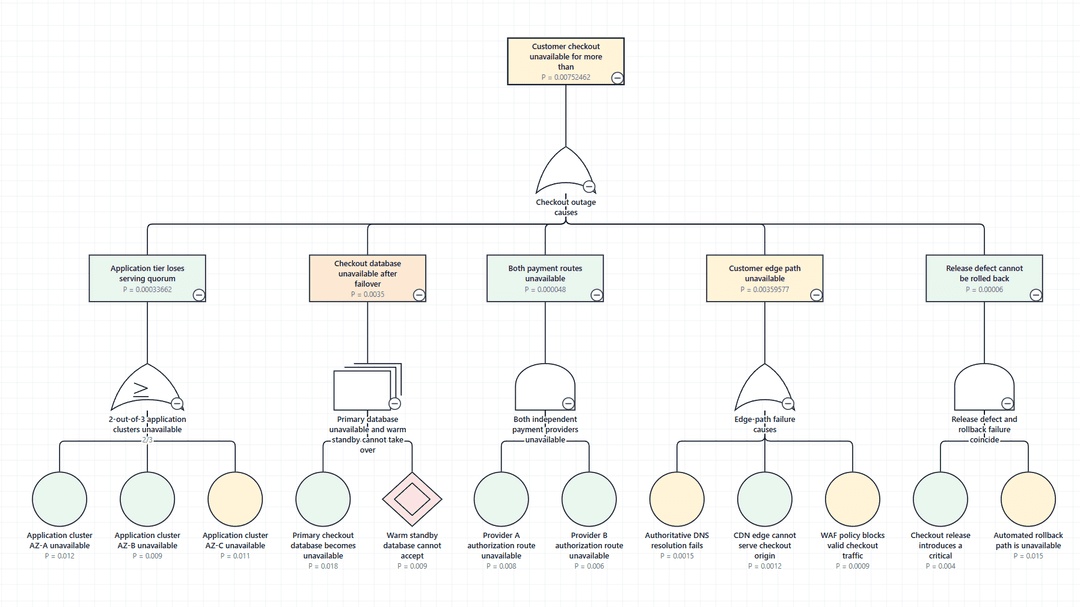
Under IEC 61025:2006 and Traditional / NUREG-0492, every gate has exactly one event above it and the number of inputs shown below. A conditional event attached to a Priority AND or Sequential gate counts as one of its inputs.
| Gate | Inputs |
|---|---|
| AND, OR, NAND, NOR | At least 2 |
| Voting | At least 2 |
| Exclusive OR | Exactly 2 |
| NOT | Exactly 1 |
| INHIBIT | Exactly 1 input, and 1 conditional event attached with the Condition relationship |
| Priority AND | At least 2, or exactly 2 when Priority AND inputs is set to Exactly two inputs, SEQ beyond that |
| Sequential | At least 3 |
| Spare | At least 1 |
| FDEP (Custom only) | Exactly 1 dependency trigger and at least 1 dependent event |
| Priority OR (Custom only) | At least 2 |
Under Custom, AND, OR, NAND, NOR, voting, exclusive OR, Priority AND, Sequential and Priority OR gates with fewer than two inputs are reported as a warning.
Voting gates
- Voting threshold (k) is required on the gate's row: a whole number from 1 to the number of inputs.
- Voting input count (n) is optional. When given, it must be a whole number of at least 2 that equals the number of inputs connected.
- A threshold of 1 behaves as an OR gate, and a threshold equal to the number of inputs behaves as an AND gate. Both are allowed and are noted as advisories.
The criterion is drawn on the gate as k/n, using the input count when given and the number of connected inputs otherwise. Set Labels → Fault tree values → Voting criterion format to k-out-of-n to draw it as 2oo3.
Priority AND, Sequential and Priority OR gates
Every input carries a Priority sequence on its own row, numbered from 1 to the number of inputs, with each number used once. A conditional event takes no number. Each number is drawn on its connector as [1], [2] and so on.
When the numbering is wrong, the validation message says which numbers are repeated, how many inputs have none, and which are outside the range.
Spare gates
| Value | On the row of | Rule |
|---|---|---|
| Spare mode | The Spare gate | Cold, Warm or Hot. The word spare may follow, as in Warm spare. |
| Required spares | The Spare gate | A whole number from 1 to the number of inputs. |
| Priority sequence | Each input | Optional. Number every input or none. |
| Dormancy factor | Each input | From 0 to 1. A cold spare implies 0 and a hot spare implies 1; a different value is flagged. |
A Spare gate with no spare mode or no required spares is flagged as incomplete. A dormancy factor on an event that is not an input to a Spare gate has no effect and is noted.
House and zero events
| Event | Probability | Event state |
|---|---|---|
| House event | 0 or 1 | TRUE or FALSE, ON or OFF, YES or NO, or 1 or 0. When both are given, the state must agree with the probability. |
| Zero event | 0 | FALSE, or blank. |
Value ranges
| Value | Allowed | Checked under |
|---|---|---|
| Probability | 0 to 1 | Every profile |
| Failure rate, repair rate, mission time | 0 or more | Every profile |
| Dormancy factor | 0 to 1 | IEC 61025:2006 and Traditional / NUREG-0492 |
| Voting threshold and input count, required spares, priority sequence, spare mode, event state | As described above | IEC 61025:2006 and Traditional / NUREG-0492 |