
Event Tree Analysis
What the event tree analysis (ETA) diagram type draws, what it calculates from your numbers, the standards that describe it, and its defaults.
What it draws
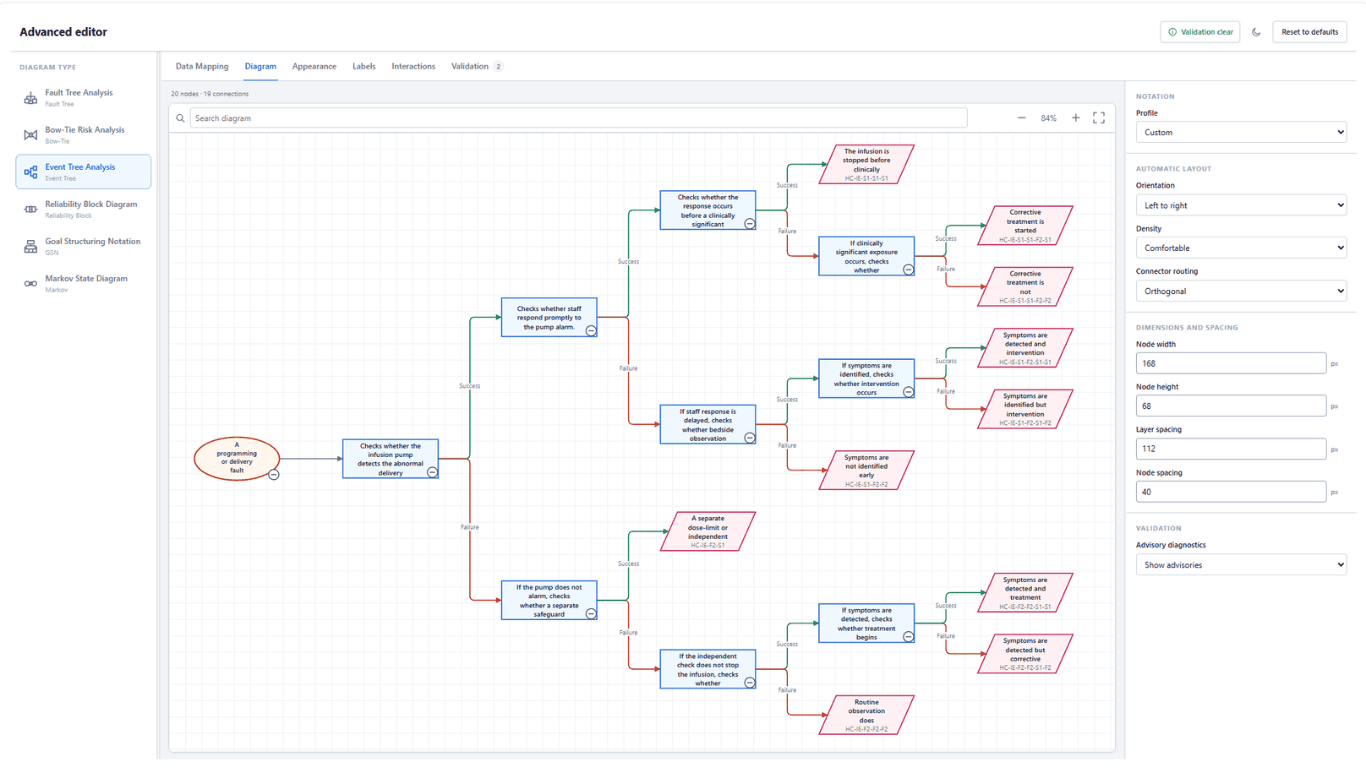
Event Tree Analysis draws what can follow an initiating event, such as a release, a power loss or a cyber incident. At each pivotal event, such as a safety system, a backup or an operator action that works or fails, the path splits into a success branch and a failure branch. Every path ends in an outcome, and each path from the initiating event to an outcome is one sequence.
The tree reads left to right, with success above failure at every split.
What it calculates
Event Tree Analysis is the one diagram type that calculates, because the arithmetic of an event tree has one agreed form. From your branch probabilities and initiating frequency, it works out three things for each sequence and writes them on the sequence's outcome.
| Calculated | How |
|---|---|
| Sequence identifier | The initiating event's Node ID, then S, F or C and the branch's position at each split, such as IE-S1-F2. |
| Path probability | The branch probabilities along the path, multiplied together. |
| Sequence frequency | The initiating frequency multiplied by the path probability, in the same units as the initiating frequency. |
It does not calculate uncertainty, importance measures or minimal cut sets, and it does not add sequences up by outcome. Nothing is calculated from values the data does not supply, and a tree with no probabilities still draws.
Standards
The IEC 62502:2010 profile is designed with reference to IEC 62502:2010, Analysis techniques for dependability – Event tree analysis (ETA). Event tree analysis also appears in IEC 31010:2019, IEC 60300-3-1:2003, IEC 61511-3:2016, ISO/TR 24971:2020 and EN 50126-2:2017. Notation standards lists what each one covers.
Defaults
| Setting | Default |
|---|---|
| Notation profile | Custom. IEC 62502:2010 is also available. |
| Orientation | Left to right. Right to left, top to bottom and bottom to top are also available. |
| Connected node is read as | The node before this row |
| Required mappings | Node ID, Node type and Relationship type |
| Node type when the cell is blank | Pivotal event |
| Relationship type when the cell is blank | Sequence |
| Connector routing | Orthogonal |
| Sequence identifier | Show on outcome |
| Sequence frequency | Show on outcome |
| Quantity format | Scientific |
| Advisory diagnostics | Show advisories |