Motion and timing
How fast a frame takes, how marks ease between positions, and what grows from zero.
What the Motion tab controls
The Motion tab governs how the chart gets from one frame to the next: how long the transition takes, how it accelerates, and which parts of the chart move rather than jump. It is separate from the Playback tab, which governs the transport a reader operates.
| Tab | Answers |
|---|---|
| Motion | How does the chart move between frames? |
| Playback | Who starts it, how fast does it run, and what can the reader do? |
Easing
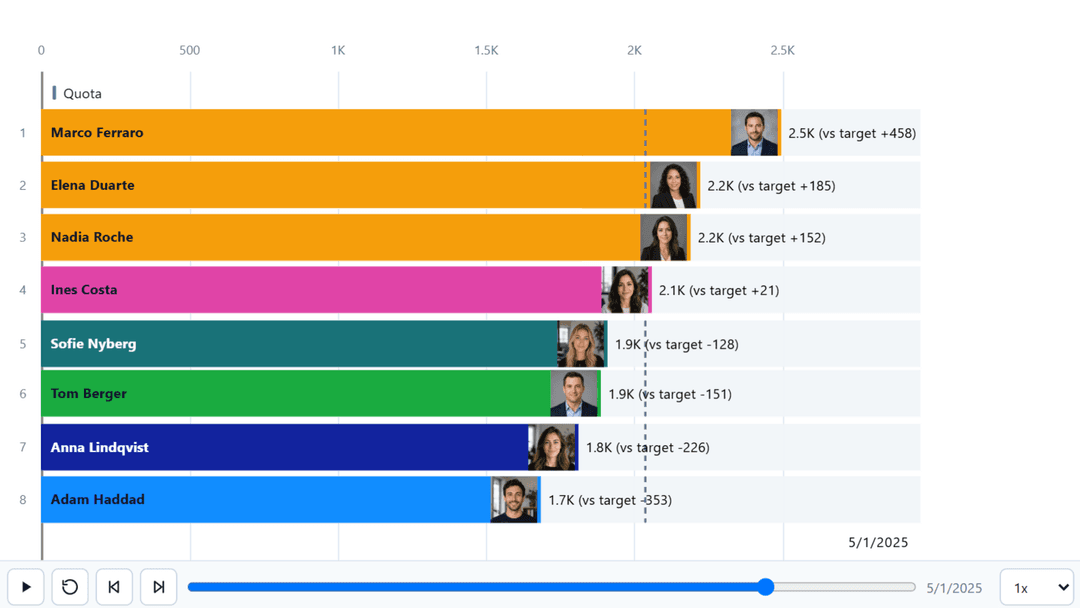
Easing decides the shape of a transition. A linear transition moves at a constant rate; an eased one starts and ends gently, which makes an overtake easier to follow because the moment of crossing is slower than the travel either side of it.
Grow from zero
A category appearing for the first time can grow from zero to its value rather than arriving at full size. On a race this is what stops a late entrant looking as though it had been there all along.
Speed
The default speed is authored and the reader can change it between 0.25x and 4x, unless the speed selector has been hidden. A race with many frames and a slow speed can run for several minutes, so it is worth watching the whole thing once before publishing.