Recipes, kits and other structures
Using Ataytis BOM beyond manufactured parts: recipes and formulations with quantities in kilograms and litres, kits and bundles, spare parts under equipment, construction assemblies and software dependencies, with a worked recipe example.
Anything made of other things
Nothing in the visual is specific to a factory. It needs a parent, a child and, when you have one, a quantity, and it treats a shared ingredient, a spare part that fits three machines or a library used by two applications exactly as it treats a shared bolt.
| Structure | Parent | Child | Quantity |
|---|---|---|---|
| Product structure | Assembly or product | Part or sub-assembly | Units per assembly |
| Recipe or formulation | Dish, batch, blend or intermediate | Ingredient or intermediate | Kilograms, litres or units per one of the parent |
| Kit or bundle | Kit, pack or bundle | Item packed in it | Units per kit |
| Spare parts | Machine, asset or module | Module or spare part | Units fitted |
| Construction or fit-out | Building element or work package | Component or material | Units per element |
| Software | Application or package | Package it depends on | Leave Quantity out |
Where used is often the question these structures are built to answer: which recipes use an ingredient that is short, which kits contain an item being withdrawn, which machines a spare part fits, or which applications depend on a library that needs updating.
A worked example: a recipe
A catering kitchen makes a platter of 12 club sandwiches and 12 fruit cups. The mayonnaise is made in-house, and lemon juice goes into both the mayonnaise and the fruit cups. Quantities are per one of the parent: per sandwich, per kilogram of mayonnaise, per fruit cup.
| Parent | Child | Quantity | Description | Unit |
|---|---|---|---|---|
| PLATTER-24 | Sandwich and fruit platter for 24 | platter | ||
| PLATTER-24 | CLUB-SW | 12 | Club sandwich | each |
| PLATTER-24 | FRUIT-CUP | 12 | Fruit cup | each |
| CLUB-SW | BREAD-SL | 3 | Bread slice | each |
| CLUB-SW | CHICKEN-KG | 0.08 | Roast chicken | kg |
| CLUB-SW | MAYO-KG | 0.015 | House mayonnaise | kg |
| MAYO-KG | EGG-YOLK | 8 | Egg yolk | each |
| MAYO-KG | OIL-L | 0.8 | Rapeseed oil | l |
| MAYO-KG | LEMON-L | 0.02 | Lemon juice | l |
| FRUIT-CUP | MELON-KG | 0.05 | Melon | kg |
| FRUIT-CUP | GRAPE-KG | 0.04 | Grapes | kg |
| FRUIT-CUP | LEMON-L | 0.005 | Lemon juice | l |
Put Parent, Child and Quantity in their wells, and Description and Unit in Details. The extended quantity of each ingredient is what one platter needs through that path:
| Position | Quantity per | Extended quantity |
|---|---|---|
| PLATTER-24 › CLUB-SW › BREAD-SL | 3 | 36 |
| PLATTER-24 › CLUB-SW › CHICKEN-KG | 0.08 | 0.96 |
| PLATTER-24 › CLUB-SW › MAYO-KG | 0.015 | 0.18 |
| PLATTER-24 › CLUB-SW › MAYO-KG › EGG-YOLK | 8 | 1.44 |
| PLATTER-24 › CLUB-SW › MAYO-KG › LEMON-L | 0.02 | 0.0036 |
| PLATTER-24 › FRUIT-CUP › LEMON-L | 0.005 | 0.06 |
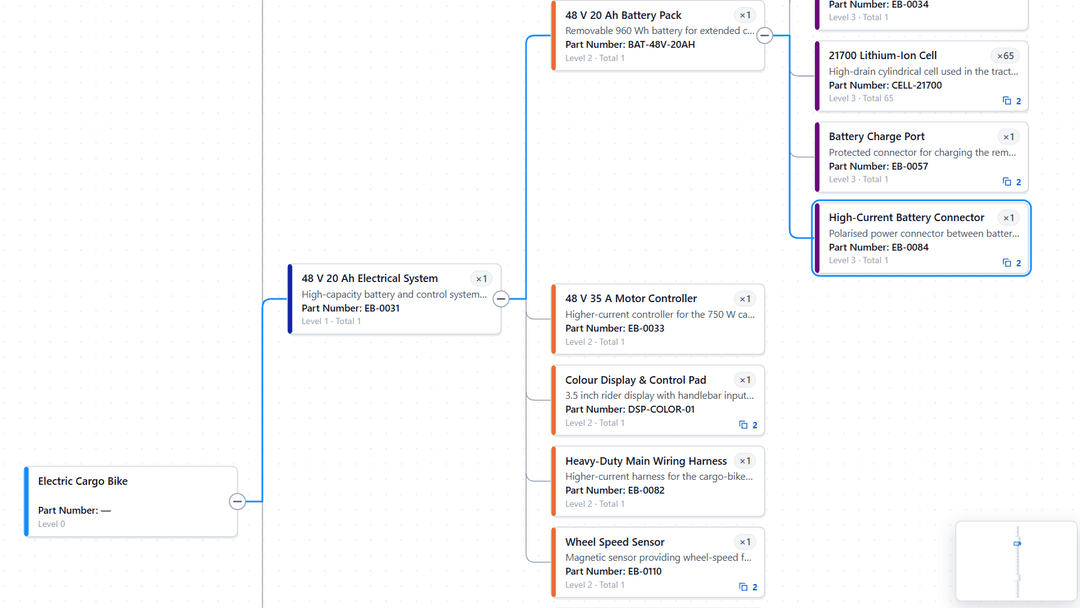
- LEMON-L is one ingredient used in two places, so it carries the shared badge with the number 2, and Where used on it shows the mayonnaise and the fruit cup above it.
- Extended quantities are per path. The lemon juice for one platter is the two paths together, 0.0636 litres; the visual shows each path, not the total.
- Set Appearance → Numbers → Quantity decimals to 3 or 4 so small quantities are not rounded away, and turn on Unit under Tree → Card content → Detail fields on cards so each card says what its quantity counts.
Kits and bundles
A kit is a parent and the items packed in it are its children, with the number of each. A kit inside another kit, such as a service kit inside a starter pack, is simply one more level. Where used on an item lists every kit and pack it goes into, which is the list to check before an item is discontinued or runs short.
Spare parts under equipment
For maintenance, the parent is the machine or asset and the children are its modules and spare parts, with how many are fitted. A part that fits several machines is shared, so the badge shows at a glance which spares are common, and Where used on a spare lists every machine it fits. Put stock, criticality or lead time in Details and colour by it on the Formatting tab.
Software dependencies
For a software bill of materials, the parent is an application or package and the child is a package it depends on. Leave Quantity out: nothing is counted, and without a Quantity the visual leaves extended quantities blank and raises no notes about them. A library several packages depend on is shared, and a dependency that eventually depends on itself is shown once and reported as a circular reference. Versions, licences or known issues go in Details.
Other hierarchies
Any Parent–Child table draws, including those where every child has only one parent, such as a chart of accounts, cost centres or a product category tree. The visual goes furthest beyond a standard hierarchy where an item appears in several places, because it keeps that item as one thing.